Giuseppe Verdi
Rigoletto
Programma
We kindly ask the audience to please read the COVID-19 informations about tickets and seats and how access the theater
In April 1850 Verdi signed a contract with the Teatro La Fenice in Venice for a new opera. The subject that the composer proposes to the librettist Francesco Maria Piave is Le Roi s'amuse, the historical drama by Victor Hugo staged at the Comédie-Française in 1832 and censored for portraying the monarchy in its worst vices. The choice is dangerous and Verdi knows it. In fact, the Venetian censorship initially did not accept the master's proposal, judging the subject "of revolting immorality and obscure triviality". To annoy the censorship is the element of the curse, which for Verdi is the driving force of all the action and the first title he designed for the opera. After a long diatribe, a compromise is reached: the action is moved by time and place, the king of France downgraded to Duke of Mantua and the work entitled with the name of the
hunchback Rigoletto. The first title of the 'popular trilogy', Rigoletto made its successful debut on 11 March 1851, establishing a decisive turning point in the opera scene of the time. For the first time the main role is entrusted to a character of humble origins, wretched and deformed. A man with a tormented personality, Rigoletto is as cynical and ruthless in carrying out the role of a jester, as well as loving and passionate in the dimension of a father. Inevitably marked by that curse that has accompanied him from the beginning of the opera, Rigoletto will lose everything, even the most expensive asset, being crushed by the weight of a destiny he cannot escape from.
New staging
Thanks to Philippe Foriel-Destezet
The first show of Rigoletto is dedicated to the soprano Edita Gruberová
In April 1850 Verdi signed a contract with the Teatro La Fenice in Venice for a new opera. The subject that the composer proposes to the librettist Francesco Maria Piave is Le Roi s'amuse, the historical drama by Victor Hugo staged at the Comédie-Française in 1832 and censored for portraying the monarchy in its worst vices. The choice is dangerous and Verdi knows it. In fact, the Venetian censorship initially did not accept the master's proposal, judging the subject "of revolting immorality and obscure triviality". To annoy the censorship is the element of the curse, which for Verdi is the driving force of all the action and the first title he designed for the opera. After a long diatribe, a compromise is reached: the action is moved by time and place, the king of France downgraded to Duke of Mantua and the work entitled with the name of the
hunchback Rigoletto. The first title of the 'popular trilogy', Rigoletto made its successful debut on 11 March 1851, establishing a decisive turning point in the opera scene of the time. For the first time the main role is entrusted to a character of humble origins, wretched and deformed. A man with a tormented personality, Rigoletto is as cynical and ruthless in carrying out the role of a jester, as well as loving and passionate in the dimension of a father. Inevitably marked by that curse that has accompanied him from the beginning of the opera, Rigoletto will lose everything, even the most expensive asset, being crushed by the weight of a destiny he cannot escape from.
New staging
Thanks to Philippe Foriel-Destezet
The first show of Rigoletto is dedicated to the soprano Edita Gruberová
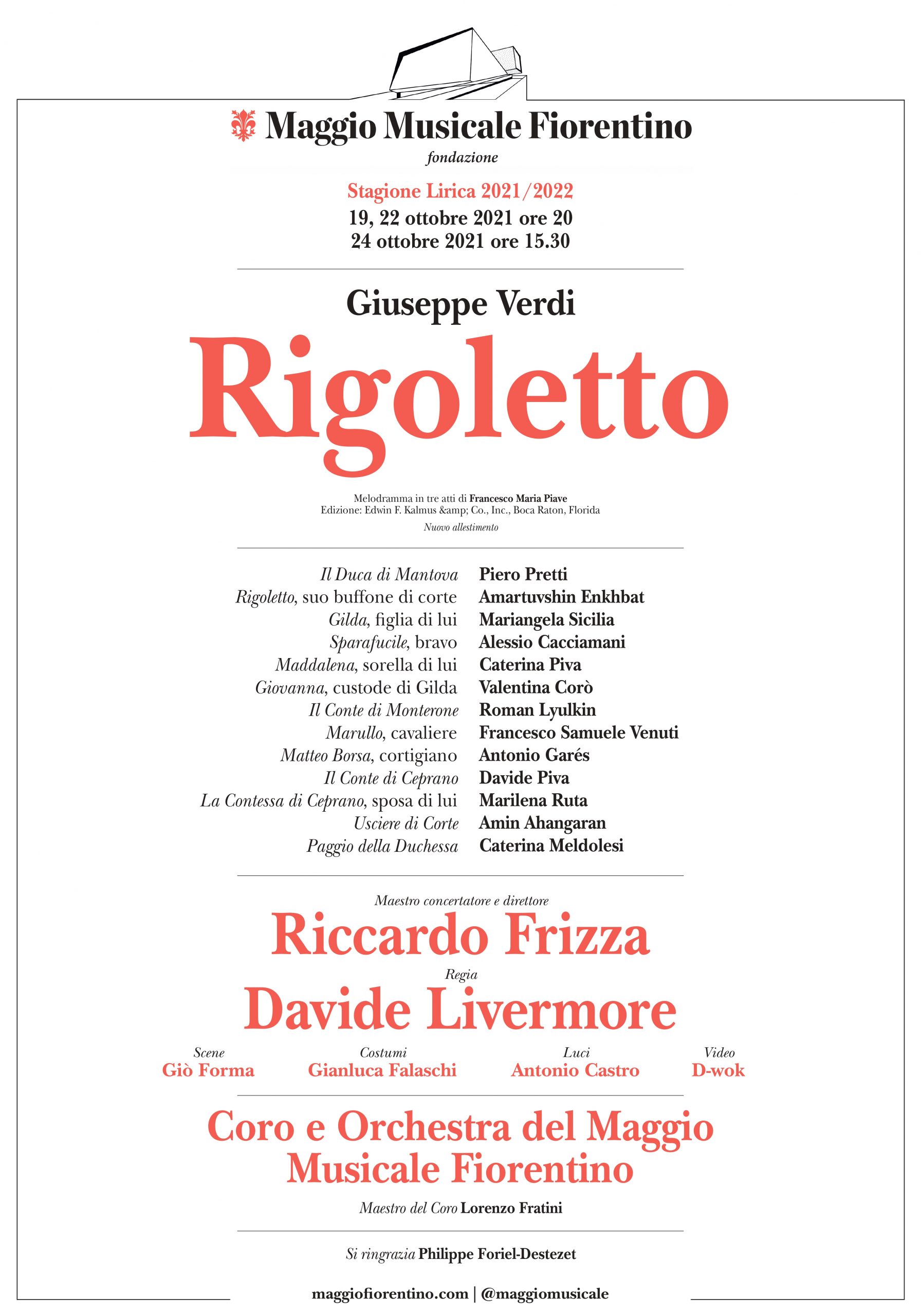
Artists
Conductor
Riccardo Frizza
Director
Davide Livermore
Sets
Giò Forma
Costumes
Gianluca Falaschi
Lights
Antonio Castro
Video
D-wok
Chorus and Orchestra del Maggio Musicale Fiorentino
Chorus master
Lorenzo Fratini
Riccardo Frizza
Director
Davide Livermore
Sets
Giò Forma
Costumes
Gianluca Falaschi
Lights
Antonio Castro
Video
D-wok
Chorus and Orchestra del Maggio Musicale Fiorentino
Chorus master
Lorenzo Fratini
Gilda
Mariangela Sicilia
Rigoletto
Amartuvshin Enkhbat
Duca di Mantova
Piero Pretti
Maddalena
Caterina Piva
Il Conte di Monterone
Roman Lyulkin
Sparafucile
Alessio Cacciamani
Giovanna
Valentina Corò
Marullo
Francesco Samuele Venuti
Matteo Borsa
Antonio Garés
La Contessa di Ceprano
Marilena Ruta
Il Conte di Ceprano
Davide Piva
Un usciere di corte
Amin Ahangaran
Un paggio
Caterina Meldolesi
Mariangela Sicilia
Rigoletto
Amartuvshin Enkhbat
Duca di Mantova
Piero Pretti
Maddalena
Caterina Piva
Il Conte di Monterone
Roman Lyulkin
Sparafucile
Alessio Cacciamani
Giovanna
Valentina Corò
Marullo
Francesco Samuele Venuti
Matteo Borsa
Antonio Garés
La Contessa di Ceprano
Marilena Ruta
Il Conte di Ceprano
Davide Piva
Un usciere di corte
Amin Ahangaran
Un paggio
Caterina Meldolesi
Running Time
Atto I: 1 ora
--------------
Intervallo: 30 minuti
--------------
Atto II e Atto III: 1 ora e 20 minuti
--------------
Durata complessiva: 2 ore e 50 minuti circa
--------------
Intervallo: 30 minuti
--------------
Atto II e Atto III: 1 ora e 20 minuti
--------------
Durata complessiva: 2 ore e 50 minuti circa
Locandina