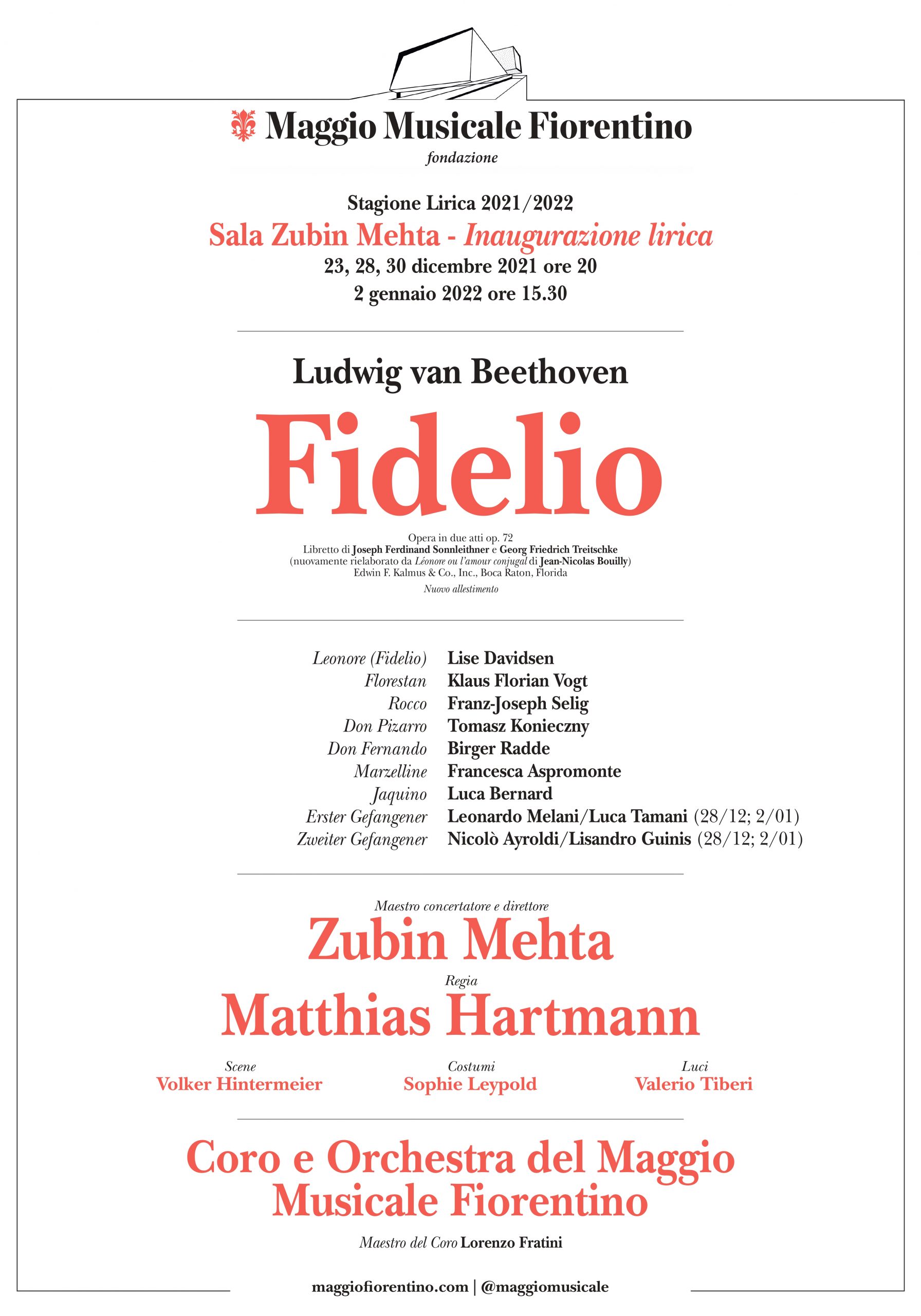
Ludwig van Beethoven
Fidelio
Programma
We kindly ask the audience to please read the COVID-19 informations about tickets and seats and how access the theater
We inform the public that the last two performances scheduled for 5 and 7 January 2022 have been canceled.
More informations -->
Unique among his works, Fidelio put Beethoven to the test. Eleven years of work and changes resulting in three versions of the opera. The story, adapted from the drama by Jean-Nicolas Bouilly, Leonora, o l’amor coniugale, was very well-known at the time, and belonged to the highly fashionable genre of the pièce de sauvetage, in which fictional and topical elements are blended together in an adventurous plot with a happy ending. The first version, from 1805, was considered long-winded, the second - a year later - was better, but still did not produce the desired results. Before returning to this untameable creature, Beethoven decided to wait, and a decade later, bolstered by his successes in instrumental music, attempted a third and final version. The libretto was revised by Georg Friedrich Treitschke, a number of pieces were eliminated, others re-written, and some passages of orchestration were touched up. On 23 May 1814, Fidelio was ready to take to the stage and finally receive the long-desired-for success. In his final version, Beethoven fully examined themes dear to him, such as the relationship between good and evil and between justice and tyranny, with the final triumph of Reason and Love, enhanced with music of epic content.
New production
We inform the public that the last two performances scheduled for 5 and 7 January 2022 have been canceled.
More informations -->
Unique among his works, Fidelio put Beethoven to the test. Eleven years of work and changes resulting in three versions of the opera. The story, adapted from the drama by Jean-Nicolas Bouilly, Leonora, o l’amor coniugale, was very well-known at the time, and belonged to the highly fashionable genre of the pièce de sauvetage, in which fictional and topical elements are blended together in an adventurous plot with a happy ending. The first version, from 1805, was considered long-winded, the second - a year later - was better, but still did not produce the desired results. Before returning to this untameable creature, Beethoven decided to wait, and a decade later, bolstered by his successes in instrumental music, attempted a third and final version. The libretto was revised by Georg Friedrich Treitschke, a number of pieces were eliminated, others re-written, and some passages of orchestration were touched up. On 23 May 1814, Fidelio was ready to take to the stage and finally receive the long-desired-for success. In his final version, Beethoven fully examined themes dear to him, such as the relationship between good and evil and between justice and tyranny, with the final triumph of Reason and Love, enhanced with music of epic content.
New production
Artists
Conductor
Zubin Mehta
Director
Matthias Hartmann
Sets
Volker Hintermeier
Costumes
Sophie Leypold
Lights
Valerio Tiberi
Chorus and Orchestra del Maggio Musicale Fiorentino
Chorus master
Lorenzo Fratini
Zubin Mehta
Director
Matthias Hartmann
Sets
Volker Hintermeier
Costumes
Sophie Leypold
Lights
Valerio Tiberi
Chorus and Orchestra del Maggio Musicale Fiorentino
Chorus master
Lorenzo Fratini
Leonore
Lise Davidsen
Florestan
Klaus Florian Vogt
Don Pizarro
Tomasz Konieczny
Don Fernando
Birger Radde
Rocco
Franz-Josef Selig
Marzelline
Francesca Aspromonte
Jaquino
Luca Bernard
First prisoner
Leonardo Melani
Luca Tamani
Second prisoner
Nicolò Ayroldi
Lisandro Guinis
Lise Davidsen
Florestan
Klaus Florian Vogt
Don Pizarro
Tomasz Konieczny
Don Fernando
Birger Radde
Rocco
Franz-Josef Selig
Marzelline
Francesca Aspromonte
Jaquino
Luca Bernard
First prisoner
Leonardo Melani
Luca Tamani
Second prisoner
Nicolò Ayroldi
Lisandro Guinis
Running Time
Atto I: 1 ora e 15 minuti
--------------
Intervallo: 30 minuti
--------------
Atto II: 1 ora e 5 minuti
--------------
Durata complessiva: 2 ore e 50 minuti circa
--------------
Intervallo: 30 minuti
--------------
Atto II: 1 ora e 5 minuti
--------------
Durata complessiva: 2 ore e 50 minuti circa
Locandina