Maggio aperto 2026
The 88th Maggio Musicale Fiorentino Festival and the network of collaborations of “Maggio Aperto”
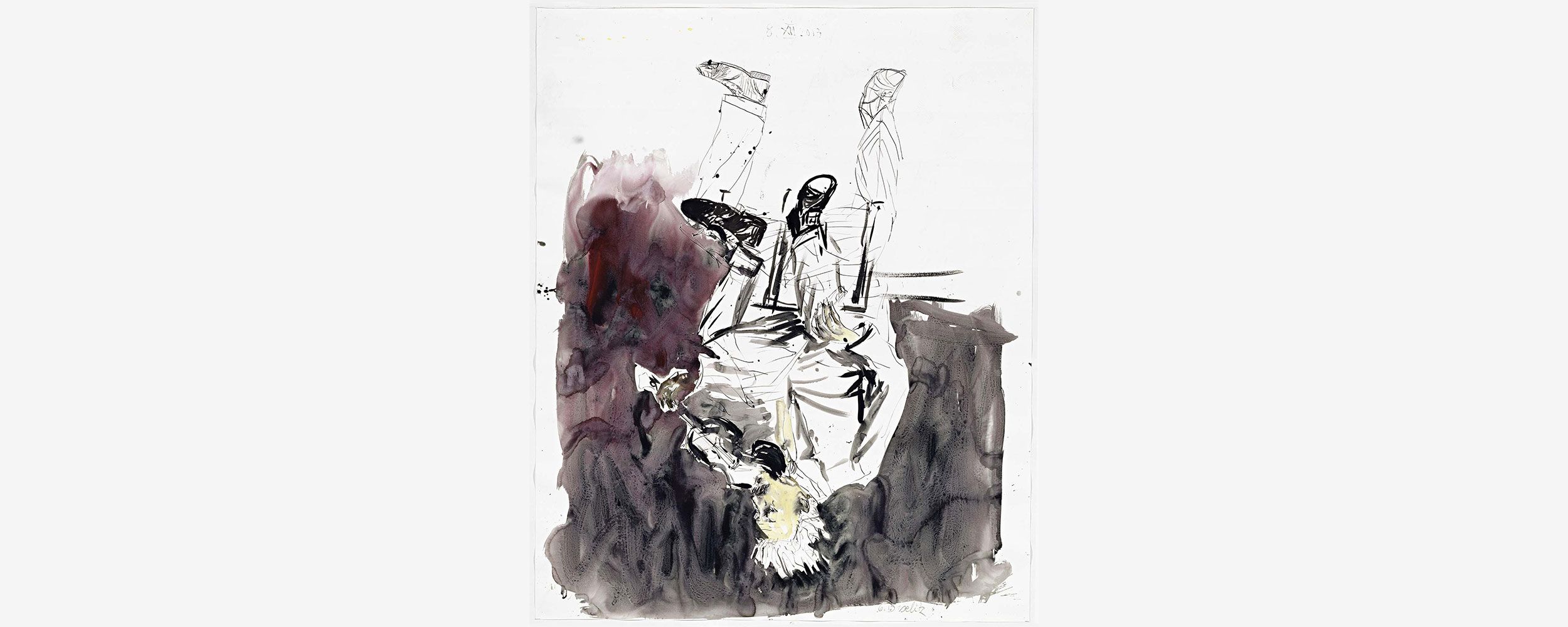
The Festival image unveiled with the poster by Georg Baselitz
Superintendent Carlo Fuortes: “A Festival that inhabits the city: from Baselitz’s revolutionary gesture to the synergy with Florence’s musical excellence, the Maggio confirms itself as a workshop of art and thought.”
The series begins featuring Amici della Musica di Firenze, Scuola di Musica di Fiesole, Conservatorio Luigi Cherubini, Accademia del Fortepiano, Tempo Reale, G.A.M.O., L’Homme Armé, and the Istituto Giovanni Battista Lulli.
Among the new additions to the program is “Una Traviata da cortile,” written and performed by Alessandro Baricco.
Tickets for the “Maggio Aperto” events go on sale starting March 13, 2026.
Florence, March 13, 2026 – The Maggio Musicale Fiorentino Festival, now in its 88th edition and officially launching the three-year tenure of Daniele Gatti as music director, presents the network of collaborations with the region’s leading institutions that form “Maggio Aperto,” along with the official Festival poster and the additional events included in the program.
“The Maggio Musicale Fiorentino was born as a festival of the city, and ‘Maggio Aperto’ brings this idea back to its most vibrant form: music meeting the city and its institutions. The poster for this Festival, created by the great artist Georg Baselitz, is not merely an image but a true cultural and artistic manifesto — a declaration of freedom and a reversal of conventions,” said Superintendent Carlo Fuortes.
“Just as Albert Einstein revolutionized the paradigms of physics and Baselitz revolutionized those of visual perception, our Festival aims to be a space where tradition constantly dialogues with the future. This spirit of discovery also inspires the ‘Maggio Aperto’ series: a project that transforms the Theatre into the heart of an extraordinary ecosystem of musical collaborations, representing a distinctive value of our city — a unique cultural network, a synergy with very few parallels in Italy. Opening our halls — the Main Hall, the Sala Mehta, the Orchestra Hall, the Choir Hall and the Regia Hall — to the most prestigious institutions in the area is an act of sharing and reciprocity that makes the Maggio a necessary common home and the centre of dialogue between the Theatre and its territory. As an integral part of the program that enriches and completes the 88th Festival, I would like to thank for their participation — in chronological order — Amici della Musica di Firenze, G.A.M.O., L’Homme Armé, Accademia del Fortepiano, Conservatorio Cherubini, Scuola di Musica di Fiesole, Istituto Lulli and Tempo Reale, institutions with which we will offer a musical journey ranging from Renaissance polyphony to the genius of Ludwig van Beethoven, reaching the frontiers of electronic avant-garde. Another important new event will also appear in the calendar: ‘Una Traviata da cortile,’ a performance by and with Alessandro Baricco, in collaboration with the University of Florence and with the support of Unicoop Firenze.”
Superintendent Carlo Fuortes also presented the network of collaborations with the city’s major institutions and the official poster of the 88th edition, created through a fruitful partnership with the Museo Novecento and its director Sergio Risaliti.
The image is signed by one of the giants of contemporary art, Georg Baselitz, who chose for the Festival a highly evocative subject: Albert Einstein captured while playing the violin. The work, characterized by the artist’s famous “inverted” figure — a hallmark of Baselitz’s style — “transforms the scientist into an icon of pure creativity, bringing together music and science in a rapid and restless gesture that challenges certainties and invites new perspectives,” explains Sergio Risaliti.
If these eight institutions now form the calendar of “Maggio Aperto,” the Festival program already announced last June had already included the collaboration with the Orchestra della Toscana (ORT). Conducted by Diego Ceretta, the orchestra returns to our theatre for a concert on June 9, together with the Coro del Maggio and the soloists of the Accademia del Maggio.
A new addition to the Festival is the concert conducted by Antonio Pappano, who on May 24 will lead the Orchestra Giovanile Italiana in a program pairing two highly impactful works. The evening opens with Johannes Brahms’s Piano Concerto No. 1 in D minor, Op. 15, featuring pianist Alexander Lonquich as soloist. The second half presents the monumental musical fresco of Dmitri Shostakovich’s Symphony No. 5 in D minor, Op. 47.
The Orchestra Giovanile Italiana will also appear in “Maggio Aperto,” where it will give a second concert.
IL MAGGIO APERTO
The “Maggio Aperto” series begins with the prestigious collaboration with the historic institution Amici della Musica di Firenze, which from April 24 will present a cycle of six concerts (followed by performances on April 28 and 30, and May 5, 9 at 4 p.m., and May 21 at 8 p.m., in the Sala Coro) titled “Beethoven 199,” anticipating the celebrations marking the 200th anniversary of the death of Ludwig van Beethoven.
The project will feature the complete performance of Beethoven’s string quartets, performed by the Quatuor Van Kuijk, Fibonacci String Quartet, Quatuor Adorno, Aviv Quartet, Quartet Integra, and Quartetto Nous.
On this occasion, the artistic director of Amici della Musica, Andrea Lucchesini, commented: “Beethoven’s music is a constant presence in concert halls, but in 2027 the bicentenary of the death of the genius of Bonn will certainly lead to an outpouring of Beethoven programming. Amici della Musica di Firenze are moving ahead of the celebrations and presenting Beethoven 199, a complete cycle of the string quartets included in the program of the 88th Maggio Musicale Fiorentino, creating a valuable co-production. Six ensembles, made up of highly accomplished musicians from different countries around the world, have accepted the invitation of Amici della Musica to shape their concert programs so that together they achieve the complete performance of all 16 quartets.”
After the first four concerts presented by Amici della Musica di Firenze, the collaboration between G.A.M.O. and the Maggio continues on Wednesday, May 6 at 8 p.m. in the Sala Regia with a program that places key trajectories of twentieth-century music in dialogue with the sensibility of contemporary creation. The program includes works by Edgard Varèse, Osvaldo Coluccino—whose Onda, spora – Atopica (2003) for nine instruments will receive its Florence premiere—and Paul Hindemith.
Francesco Gesualdi, director of G.A.M.O., expressed his satisfaction and “genuine pride” in thanking the Maggio for the invitation to participate in the program: “The collaboration with the Maggio represents a historic and meaningful relationship which, in the context of Maggio Aperto, finds renewed momentum and a particularly valuable perspective. We are deeply honored that the Theatre has chosen to recognize GAMO as a historic institution to which it can entrust projects dedicated to contemporary classical chamber music. I hope this collaboration will offer audiences stimulating and meaningful listening opportunities, helping to promote the music of our time within such a prestigious institution.”
From the contemporary sound world of G.A.M.O., the program then leaps back in time on Wednesday, May 13 at 8 p.m. in the Sala Mehta, with L’Homme Armé presenting a monographic madrigal workshop dedicated to Claudio Monteverdi, led by Fabio Lombardo and titled “O dolcezze amarissime d’Amore – Monteverdi, the poets, and the shifting fortunes of love.”
The program includes a selection of pieces drawn from Monteverdi’s madrigal books (the Third, Fifth, Sixth and Seventh), published between 1592 and 1619, exploring the “new music” and the dramatic expression of human emotions.
Renato Baldassini described the concert program while recalling past collaborations with the Maggio: “The collaborations realized in previous editions, with the concerts In terra Pax in 2024 and Lume alla terra in 2025, presented wonderful musical treasures by composers such as Josquin des Prez and Heinrich Isaac, Monteverdi and Giovanni Gabrieli—milestones in the history of music—revealed to a large audience that was admiring and, in some cases, surprised by such beauty. For this Festival edition, L’Homme Armé presents a monographic program dedicated to Claudio Monteverdi, with pieces exploring the many facets of love, filtered through Monteverdi’s expressive language and that of several contemporary poets.”
On Thursday, May 14 at 8 p.m. in the Orchestra Hall, the cycle of five concerts by the Accademia del Fortepiano Bartolomeo Cristofori begins. The other dates are May 19, May 26, June 3, and June 9.
Five performers will take turns performing on five original fortepianos: Roberto Prosseda (May 14), Olga Pashchenko (May 19), Wolfgang Brunner (May 26), Jin Ju (June 3), Yuan Sheng (June 9).
The series, a project by Stefano Fiuzzi, is titled “Da Paesi e popoli lontani…” (From Distant Lands and Peoples…) and draws inspiration from the famous piano piece “Von fremden Ländern und Menschen” by Robert Schumann, evoking a musical journey through different cultures, styles and national traditions.
Each of the five performers has been invited to design an evocative program that pays tribute to their own musical culture or to a specific national tradition. The aim is to transform each concert into a kind of “musical portrait,” in which repertoire, style and historical instrument interact to offer audiences a vivid and authentic perspective on nineteenth-century European music.
The selected programs will include works by Wolfgang Amadeus Mozart, Ludwig van Beethoven, Schumann, Felix Mendelssohn, Frédéric Chopin, Fanny Hensel, and Mikhail Glinka, offering a broad journey through piano repertoire from Classicism to Romanticism, explored through the timbre and expressive qualities of period instruments.
The president of the Academy, Mauro Campus, stated: “Last year the collaboration between the Accademia Bartolomeo Cristofori and the Maggio passed the ten-year mark. This is not only a reason for pride; above all, it is a sign of institutional vitality. When two musical and cultural institutions choose to engage in dialogue over time, giving their relationship continuity, they give concrete form to a civic duty even before an artistic one. In an era when dialogue often becomes rigid and the arts themselves sometimes retreat into increasingly narrow boundaries—whether aesthetic, disciplinary or ultimately political—the signal offered by the Maggio in maintaining and strengthening this collaboration points in the opposite direction: openness, permeability, encounter. This encounter is not abstract but rooted in the city, in its musical associations and in the many realities that nourish its cultural vitality. For this reason we are particularly pleased to present this new chapter in the collaboration between the Accademia del Fortepiano and the Maggio. This year it offers the Festival audience a cycle of five concerts. The program moves with natural elegance across a wide repertoire while restoring these works to their concrete historical dimension: the possibility of hearing them on the instruments for which they were conceived. That this spirit of dialogue and openness finds a place in the 88th edition of the Maggio Festival confirms the deeply collective nature of the event and reiterates a simple conviction: dialogue among the arts is not an ornament of the Festival but one of the conditions that make its very existence possible. Ultimately, it is precisely in the space of dialogue that music realizes, in practice, its democratic vocation.”
The future of music is shaped in its most prestigious training grounds: the Scuola di Musica di Fiesole and the Conservatorio Luigi Cherubini.
On Saturday, May 30 at 8 p.m. in the Sala Coro, the first concert featuring the Conservatorio di Musica Luigi Cherubini di Firenze will take place. The second will follow, again in the Sala Coro at 8 p.m., on Friday, June 12. The programs for the two concerts have not yet been finalized but will include important works from the classical repertoire. The ensembles of young musicians will be selected from the Conservatory’s chamber music and string ensemble classes.
The president of the Conservatory, Rosa Maria Di Giorgi, stated: “These two concerts confirm the collaboration between our two institutions, now in its third year. The Conservatory is proud to present to the audience of the Maggio Festival musicians who are close to completing their studies, with a level of training that reflects the excellence achieved by the Cherubini within the AFAM institutions.”
Alongside her, the director of the Conservatory, Giovanni Pucciarmati, emphasized: “It is a valuable opportunity for Conservatory students who are about to enter the profession to perform in a context of international importance and to test themselves under the best possible conditions. It is not every day that one has the chance to play in the halls of the Theatre: this experience alone provides students with a unique level of concentration for performance.”
On Sunday, May 31 at 8 p.m., the Orchestra Giovanile Italiana returns to perform in the Sala Mehta—after the concert conducted by Antonio Pappano as part of the Festival—for the “Maggio Aperto” series. The orchestra will be conducted by the young and rapidly rising Dayner Tafur-Díaz in a kaleidoscopic program. Alongside the luminous writing of Kauyumari and Antrópolis by Mexican composer Gabriela Ortiz, the program features the distinctive sounds of Cuban Overture by George Gershwin, culminating in the visionary and monumental Symphonie fantastique by Hector Berlioz.
Anna Maria Meo, superintendent of the Scuola di Musica di Fiesole, commented: “The Scuola di Musica di Fiesole thanks the Maggio Musicale Fiorentino for including the Italian Youth Orchestra in the calendar of the 88th Festival. The first concert will see Sir Antonio Pappano on the podium who, after a warm visit to the School, said he was delighted to work with the OGI and with our artistic director Alexander Lonquich, appearing as piano soloist. The second concert, within the ‘Maggio Aperto’ series, promotes the meeting between the talented musicians of the Youth Orchestra and the equally young Peruvian conductor Dayner Tafur-Díaz, who will certainly bring them energy and enthusiasm. The Scuola di Musica di Fiesole is also present in two additional events of the cycle, with some of the finest chamber ensembles from Fiesole sharing with audiences music of great charm, including works that are rarely performed.”
As the superintendent noted, the Scuola di Musica di Fiesole will also appear in two further concerts in the “Maggio Aperto” series, presenting chamber ensembles formed by talented students from its advanced courses.
On Sunday, June 7 at 8 p.m. in the Sala Coro, the program will focus on the warm voice of the clarinet between Romanticism and the twentieth century, with works by Francis Poulenc, Felix Mendelssohn, and Igor Stravinsky, alongside the intimate and reflective Clarinet Quintet in B minor, Op. 115 by Johannes Brahms.
On Saturday, June 13 at 8 p.m., again in the Sala Coro, three brilliant saxophones open the second chamber concert curated by the Scuola di Musica di Fiesole, with works by American composers Marc Mellits and Chris Evan Hass. The Quartetto Oblaka continues the program with the dramatic String Quartet No. 8 in C minor, Op. 110 by Dmitri Shostakovich, dedicated “to the victims of fascism and war,” and the String Quartet in D major, Hob.III:42, Op. 33 No. 6, the last of the so-called “Prussian” quartets by Joseph Haydn.
The Sala Mehta will host the Istituto Giovanni Battista Lulli, with Samuele Lastrucci leading the Orchestra Modo Antiquo and the Coro dei Musici del Gran Principe. The concert, titled “Le Grand Théâtre de Dieu: Splendori del barocco sacro francese nel tricentenario di Michel-Richard de Lalande”, will take place Thursday, June 11 at 8 p.m. and features sacred music bridging the 17th and 18th centuries. It offers an aesthetic exploration of the devotional production of the French Grand Siècle, highlighting a generation of composers influenced by Jean-Baptiste Lully but little performed in Italy today. The program includes works by Michel-Richard de Lalande, Sébastien de Brossard, Jean Gilles, and a 2019 composition by Federico Maria Sardelli, Jesu dulcis memoria, dedicated to Lastrucci.
The Maggio Aperto series concludes on Saturday, June 20 at 8 p.m. in Sala Orchestra with Tempo Reale presenting Maggio Elettrico.
The Tempo Reale Electroacoustic Ensemble celebrates the legacy of the Fluxus movement, one of the most radical and influential avant-gardes of the 20th century, transforming musical performance into gesture, relationship, daily action, and expanded listening. Fluxus Tree is a project that explores this heritage through scores derived directly from Fluxus experiences—such as performative actions by Yoko Ono or sound events by Giuseppe Chiari—and works by artists sharing Fluxus’s spirit and practices, like Toshi Ichiyanagi and John Cage.
The concert is conceived as an improvisational journey combining open instructions, graphic scores, and sound actions. Performance space itself becomes a key element: the relationship between musicians, the space, and the audience is continuously redefined, breaking the traditional divide between performers and listeners.
Francesco Giomi comments: “Fluxus remains relevant today as a model of musical practice capable of merging intermediality, participation, and daily life, providing a playful and critical response to the digital spectacle of contemporary sound art.”
EXTRA
There are important “extra” additions to the Festival’s program: the first, soon to be announced and added to the schedule, is the theatrical and musical project “Una Traviata da cortile”, conceived and narrated by Alessandro Baricco, realized in collaboration with the University of Florence and with the support of Unicoop Firenze.
During the Festival, on June 13 at 6:00 PM in Sala Mehta, the concert Rothko Chapel for soprano, alto, choir, viola, celesta, and percussion by Morton Feldman will be presented—a work considered one of the most intense and conceptually radical pieces of late 20th-century music. It was previously performed in March in Sala Orchestra on the initiative of Palazzo Strozzi, in collaboration with the Maggio Musicale Fiorentino and its Academy, on the occasion of the exhibition “Rothko in Florence” (March 14 – August 23, 2026). The piece offers a profound dialogue between sound, space, and silence, resonating closely with the work of Mark Rothko. The choral ensemble of the Accademia del Maggio Musicale Fiorentino will be conducted by the Maggio Choir director Lorenzo Fratini.
During the Festival, on May 7 at 7:00 PM in Sala Coro, the last of three public masterclasses organized in synergy with the Accademia del Maggio will take place. The soprano Eleonora Buratto will lead the session with the young talents of the academy, working on arias by Verdi, Mozart, and Massenet. These masterclasses are part of the Accademia del Maggio’s educational program, which combines formal training with intensive engagement with renowned artists. In this case, the learning experience is shared with the public, following a practice common in many international music institutions, where the public dimension of a masterclass has both formative and educational value.
On May 20 and 21 in Sala Mehta, the Festival will host a highly anticipated stop on Ludovico Einaudi’s European tour. The concert, following the release of the album “Solo Piano” (Decca, February 27, 2026), revisits thirty years of his legendary career. In an intimate and essential setting, Einaudi will perform his most iconic pieces—from Nuvole Bianche to Experience—alongside recent works such as Adieux and the new piece Memory One. A solitary journey across the 88 keys, this performance confirms Einaudi as one of the most influential composers in the contemporary global music scene.
BEYOND THE CURTAIN: Meetings, Lessons, Insights
As part of the “Beyond the Curtain” series organized by the Maggio to explore the works and concerts on the program before their performance, a series of events is offered to guide the audience in discovering the masterpieces through guided listening and historical context.
On the occasion of the complete performance of Ludwig van Beethoven’s Symphonies conducted by Daniele Gatti, Giovanni Bietti will hold two lessons in Sala Coro at 11:00 AM. On June 21, the analysis will focus on Symphonies Nos. 1 through 6, while on June 28, the series will conclude with an introduction to Symphonies Nos. 7, 8, and 9—a valuable opportunity to explore the evolution of the Bonn genius. Admission: €5.
In collaboration with Il Foyer – Amici della Lirica di Firenze, two lectures are scheduled in the Foyer of the Galleria at 4:30 PM, dedicated to two operatic works of the Festival. On May 8, Alberto Batisti will present “Verdi and the Unbearable Lightness of the Ballo,” an exploration of the dramatic and brilliant nuances of Un ballo in maschera. On June 10, Martino Ruggero Dondi will lead the lecture “The Ancient on Stage: Handel’s Giulio Cesare,” dedicated to the magnificence of Handelian baroque.
On May 12 at 5:00 PM, also in the Foyer of the Galleria, the volume published by Zecchini will be presented: “Giacomo Meyerbeer, Glory and Disdain! Life, Works, Legacy.” The author Maurizio Modugno will participate alongside Giancarlo Landini and Giovanni Vitali, offering a rediscovery of a composer who shaped an era in the history of musical theater. Admission to the lectures and book presentation is free until seats are filled.