Johann Strauss Jr.
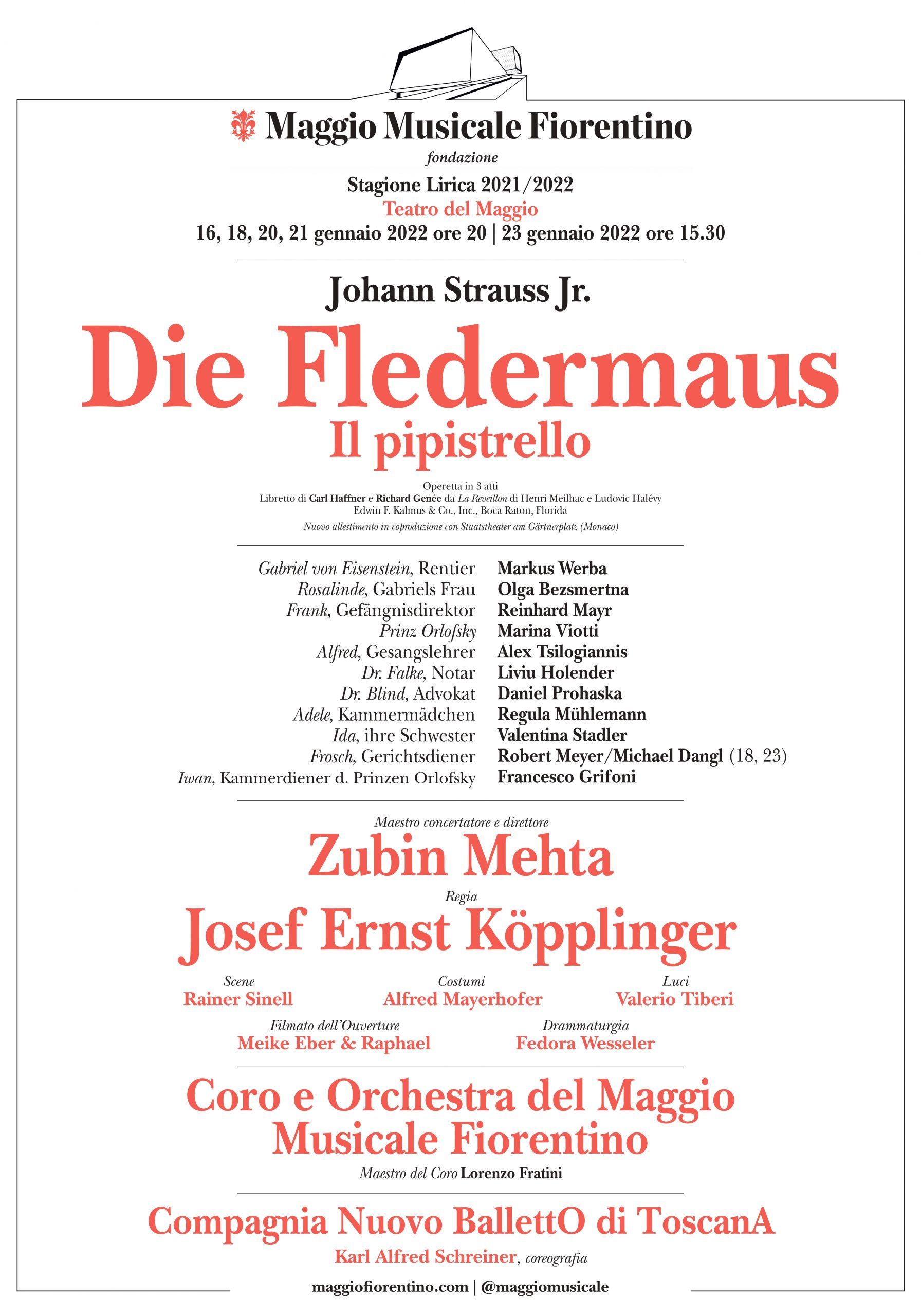
Die Fledermaus
Programma
We kindly ask the audience to please read the COVID-19 informations about tickets and seats and how access the theater
The genre of operetta born in Napoleon III's Paris quickly spread throughout Europe and found its second home in Vienna. Among the many to be seduced also the most famous and prolific of the sons of the Father of the waltz, Johann Strauss jr. who sanctioned his fortune with Die Fledermaus (The bat), an operetta inspired by Le réveillon by Meilhac and Halévy and staged at the Theater an der Wien on April 5, 1874. At the center is the classic love triangle, with consequent deceptions and scenes of jealousy, in the joyful setting of a masked party where the disguise guarantees an otherwise impossible freedom for the protagonists. In the cloudiness induced by the fumes of champagne that cheers up the party, the secret of happiness seems to be hidden: better to forget, even if momentarily, rather than accept the inevitable. Thus the lightness and disenchantment of the story translate musically into a phantasmagoric montage of heterogeneous musical elements. Obviously the beating heart of Die Fledermaus beats to the ternary rhythm of a waltz but the musical potpourri created by Strauss also includes polkas, arias that make the Italian opera verse, citations of the hits of the moment (the operettas of Offenbach) and folkloric pieces, such as the csárdás sung by Rosalinda at the party.
New production in coproduction with the Staatstheater am Gärtnerplatz (Munich)
The genre of operetta born in Napoleon III's Paris quickly spread throughout Europe and found its second home in Vienna. Among the many to be seduced also the most famous and prolific of the sons of the Father of the waltz, Johann Strauss jr. who sanctioned his fortune with Die Fledermaus (The bat), an operetta inspired by Le réveillon by Meilhac and Halévy and staged at the Theater an der Wien on April 5, 1874. At the center is the classic love triangle, with consequent deceptions and scenes of jealousy, in the joyful setting of a masked party where the disguise guarantees an otherwise impossible freedom for the protagonists. In the cloudiness induced by the fumes of champagne that cheers up the party, the secret of happiness seems to be hidden: better to forget, even if momentarily, rather than accept the inevitable. Thus the lightness and disenchantment of the story translate musically into a phantasmagoric montage of heterogeneous musical elements. Obviously the beating heart of Die Fledermaus beats to the ternary rhythm of a waltz but the musical potpourri created by Strauss also includes polkas, arias that make the Italian opera verse, citations of the hits of the moment (the operettas of Offenbach) and folkloric pieces, such as the csárdás sung by Rosalinda at the party.
New production in coproduction with the Staatstheater am Gärtnerplatz (Munich)
Artists
Conductor
Zubin Mehta
Director
Josef Ernst Köpplinger
Sets
Rainer Sinell
Costumes
Alfred Mayerhofer
Lights
Valerio Tiberi
Choreography
Karl Alfred Schreiner
Video in the Overture
Meike Eber and Raphael Kurig
Dramaturgy
Fedora Wesseler
Chorus and Orchestra del Maggio Musicale Fiorentino
Chorus master
Lorenzo Fratini
Compagnia Nuovo BallettO di ToscanA
Zubin Mehta
Director
Josef Ernst Köpplinger
Sets
Rainer Sinell
Costumes
Alfred Mayerhofer
Lights
Valerio Tiberi
Choreography
Karl Alfred Schreiner
Video in the Overture
Meike Eber and Raphael Kurig
Dramaturgy
Fedora Wesseler
Chorus and Orchestra del Maggio Musicale Fiorentino
Chorus master
Lorenzo Fratini
Compagnia Nuovo BallettO di ToscanA
Gabriel von Eisentstein
Markus Werba
Rosalinde
Olga Bezsmertna
Alfred
Alex Tsilogiannis
Adele
Regula Mühlemann
Frank
Reinhard Mayr
Orlofsky
Marina Viotti
Falke
Liviu Holender
Blind
Daniel Prohaska
Blind
Daniel Prohaska
Ida
Valentina Stadler
Frosch/Narrator
Robert Meyer/Michael Dangl (18, 23)
Ivan
Francesco Grifoni
Markus Werba
Rosalinde
Olga Bezsmertna
Alfred
Alex Tsilogiannis
Adele
Regula Mühlemann
Frank
Reinhard Mayr
Orlofsky
Marina Viotti
Falke
Liviu Holender
Blind
Daniel Prohaska
Blind
Daniel Prohaska
Ida
Valentina Stadler
Frosch/Narrator
Robert Meyer/Michael Dangl (18, 23)
Ivan
Francesco Grifoni
Running Time
Atto I: 50 minuti
--------------
Intervallo: 30 minuti
--------------
Atto II e Atto III: 1 ora e 40 minuti
--------------
Durata complessiva: 3 ore circa
--------------
Intervallo: 30 minuti
--------------
Atto II e Atto III: 1 ora e 40 minuti
--------------
Durata complessiva: 3 ore circa
Locandina