Myung-Whun Chung at the Teatro del Maggio: May 25, 2024
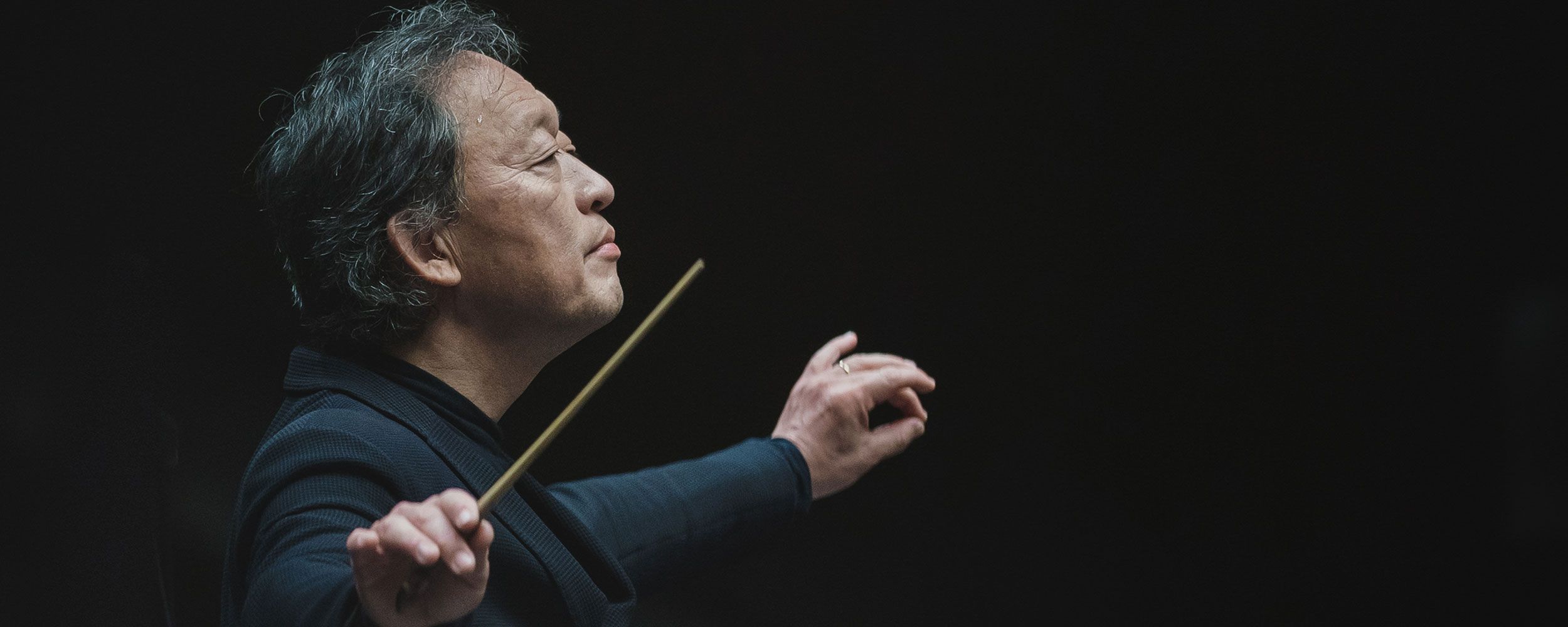
On Saturday 25 May 2024, at 8pm, maestro Myung-Whun Chung returns to the Teatro del Maggio.
The music of Franz Schubert and Johannes Brahms is on the program.
The City of Florence, "for having indelibly enriched the cultural life of Florence" confers "Le Chiavi della Città" to maestro Myung-Whun Chung on Thursday, May 23rd 2024.
We inform the public that tickets for Maestro Chung's concert are sold out in every seating order.
We thank the Slvb Law Firm – Florence for its contribution
Florence, May 23rd 2024 - One year after his last Florentine concert, maestro Myung-Whun Chung returns to the podium in the Mehta Hall – Saturday, May 25th at 8pm - in his now 'traditional' spring symphonic event, within of the 86th Maggio Musicale Fiorentino Festival. Tickets for Master Chung's concert are sold out in every seating order.
On the agenda, on the lecterns of the Orchestra del Maggio, is a program that opens with one of Franz Schubert's most famous compositions, Symphony no. 8 in B minor D. 759, known as Unfinished Symphony: written in 1822, Schubert's penultimate symphony owes its nickname to the fact that it is made up of only the two initial movements, the composer himself also never had the opportunity to hear it performed live ; it was in fact offered to the public only forty years after his death, thanks to the fortuitous discovery of the orchestra director Johann Herbeck.
The concert ends with Symphony no. 4 in E minor op. 98 by Johannes Brahms: it was presented to the public for the first time in October 1885 with the composer himself conducting, immediately achieving great success.
The maestro Myung-Whun Chung, who has linked his name to that of the Maggio for almost forty years, therefore returns as a protagonist on the podium of the Zubin Mehta Hall almost exactly one year after his last Florentine performance, which took place on May 5th 2023: a strong and constant bond, developed since the Florentine debut in March 1985 with a symphony concert. Countless shows were directed by Chung during the seasons of the Theatre, of which, in 1987, the maestro was appointed principal guest director, a position he would hold for the next five years. In addition to the symphonic repertoire - which has made Myung-Whun Chung among the most important conductors of our times - some of the opera titles he directed on the Florentine stage are also memorable, including Modest Mussorgsky's Boris Godunov from the autumn of 1987 and Verdi's Simon Boccanegra the following year.
To seal this important relationship with the Maggio and with the City, and "for having indelibly enriched the cultural life of Florence", on Thursday, May 23rd 2024, during a sober ceremony held in the Theater, the mayor Dario Nardella handed over to the maestro “The Keys to the City”.
The next symphonic event on the program of the 86th Maggio Festival features the concert by maestro Riccardo Bisatti leading the Orchestra della Toscana, scheduled for Saturday 1 June 2024 at 8 pm, again in Sala Mehta.
The program:
Franz Schubert
Symphony no. 8 in B minor D. 759, Unfinished Symphony
Composed in 1822, Schubert's penultimate symphony owes its nickname "Unfinished" to the fact that it consists of only two initial movements. None of the hypotheses formulated on the possible reasons that led Schubert not to complete this composition has ever managed to provide a univocal and definitive answer. Performed only forty years after the composer's death, thanks to the fortuitous discovery of the conductor Johann Herbeck, the Symphony seems to be affected by the dramatic state of mind in which Schubert found himself in that period, aware of being suffering from an incurable disease. The Schubert of enchanting melodies known to most presented himself in this Symphony in a new light made of shadows and desperation. Think of the irreconcilable contrast in the first movement between the tragedy of the first theme and the dancing movements of ländler of the second theme, or of the play of pathos-filled chiaroscuro of the Andante con moto which leaves the horizon open on this jewel of musical perfection despite its incompleteness.
Johannes Brahms
Symphony no. 4 in E minor op. 98
During the summer holidays of 1884 and 1885 Brahms was busy composing Symphony No. 4 in E minor op. 98, the last of his catalogue. Almost ten years had passed since his first and much feared test in the symphonic field and Brahms had now confirmed his value in the field by building his own language step by step in the sign of classicism revised through romantic sensitivity. In his latest symphonic creation, compositional virtuosity is combined with a cantability imbued with melancholy, giving life to a musical discourse where every thematic idea is meticulously shaped before finding their ideal location. The first movement, for example, is built entirely starting from an interval of a third and its inversion; these are minimal materials but which in the hands of the craftsman of Brahms notes are exploited to their full potential. The second theme is also built on third intervals as are all the other thematic ideas that seem to germinate from that same seed with infinite potential. And if in the initial Allegro the composer builds an entire and complex movement with a few simple intervals, in the grandiose final Allegro he decides to show off the highest contrapuntal mastery. In fact, Brahms closes the short but intense chapter of his symphonic production with a Chaconne - a series of variations on a bass ostinato - based on a theme derived from Bach's Cantata BWV 150, thus celebrating the musical tradition to which it belongs and establishing at the same time, the point of no return of romantic symphonism.