“Un ballo in maschera”: from May 12. Emmanuel Tjeknavorian on the podium; Valentina Carrasco, director
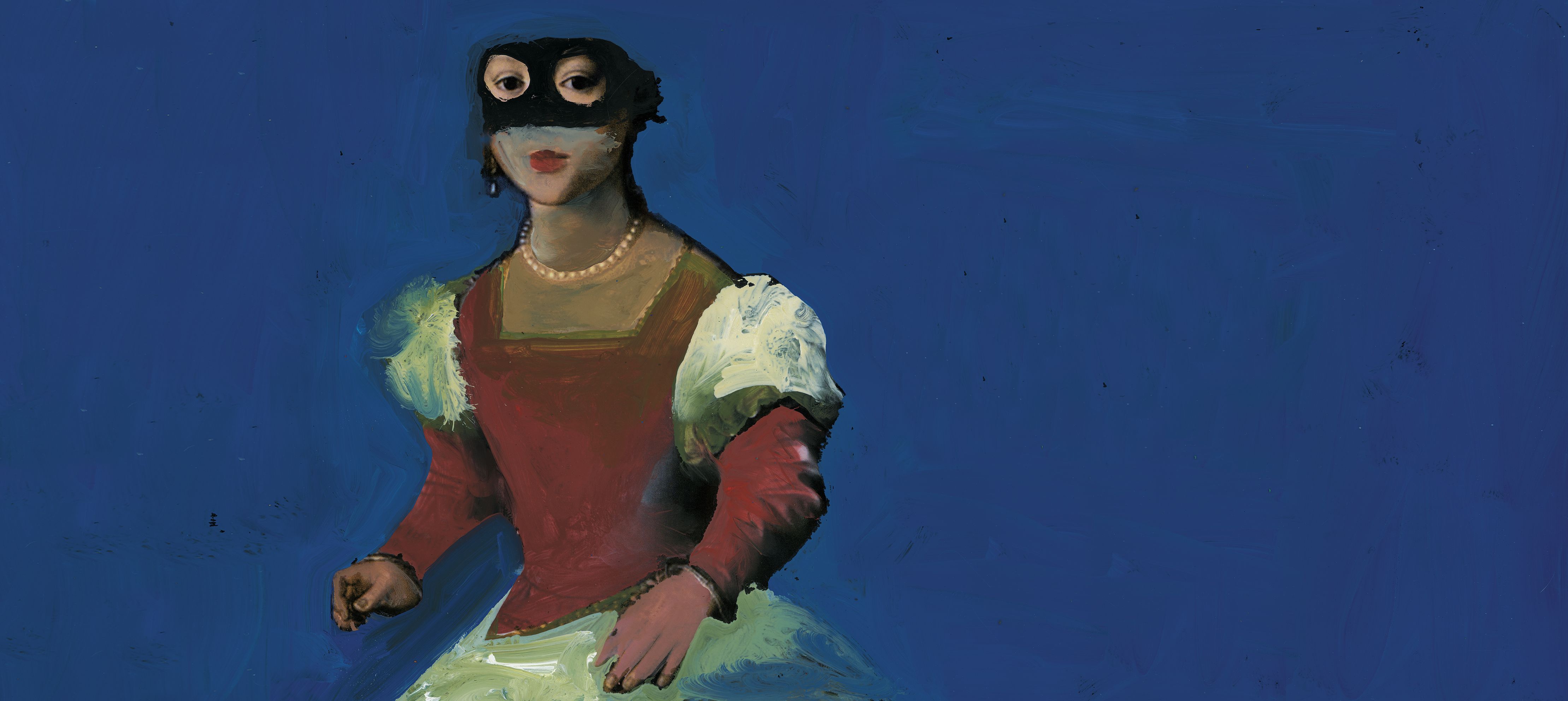
Second opera of the 88th Maggio Musicale Fiorentino Festival: Un ballo in maschera by Giuseppe Verdi
From 12 to 24 May, for five performances, Giuseppe Verdi’s Un ballo in maschera will be staged in the Main Hall of the Teatro del Maggio.
On the podium conducting the Orchestra and Chorus of the Maggio Musicale Fiorentino is Maestro Emmanuel Tjeknavorian, with stage direction by Valentina Carrasco.
In the leading roles, Antonio Poli and Max Jota (22 May performance) appear as Riccardo; Bogdan Baciu and Hae Kang (performances on 15 and 22 May) perform the role of Renato; Chiara Isotton and Alessia Panza (22 May performance) portray Amelia, while Lavinia Bini is Oscar.
New production
Poster artwork © Gianluigi Toccafondo
The opening performance will be broadcast live on Rai Radio3.
Florence, 8 May 2026 - Following the great success of the contemporary drama The Death of Klinghoffer, which inaugurated the 88th Maggio Musicale Fiorentino Festival, the Main Hall will host, from Tuesday 12 May, a highly anticipated new production of Un ballo in maschera. With this staging of Verdi’s masterpiece — a meditation on love and power — the Maggio reaffirms its commitment to presenting the great operatic repertoire through renewed interpretations capable of restoring the dramatic force and contemporary relevance of these works.
Last performed at the Maggio in concert form in the Cavea in 2020, the opera has not appeared in a fully staged production at the Festival since 1995.
Conducting the Orchestra and Chorus of the Maggio Musicale Fiorentino is Maestro Emmanuel Tjeknavorian, while the production is directed by Valentina Carrasco. Five performances are scheduled: Tuesday 12, Friday 15 and Friday 22 May at 8 p.m., and Sunday 17 and Sunday 24 May at 3:30 p.m.
For this new production, sets are designed by Andrea Belli, costumes by Silvia Aymonino, lighting by Marco Filibeck, and video design by Massimo Volpini.
The cast includes Antonio Poli and Max Jota (22 May performance) as Riccardo; Bogdan Baciu and Hae Kang (performances on 15 and 22 May) as Renato; Chiara Isotton and Alessia Panza (22 May performance) as Amelia; and Lavinia Bini as Oscar. Ksenia Dudnikova performs the role of Ulrica; Janusz Nosek is Silvano; Mattia Denti appears as Samuel; and Adriano Gramigni as Tom. Completing the cast are Francesco Congiu and Roberto Miani as the Judge and Amelia’s Servant respectively.
Making both his debut at the Maggio and his first-ever operatic conducting appearance, Emmanuel Tjeknavorian highlighted the musical and interpretative contrasts that lie at the heart of Verdi’s score: “There are operas that reveal themselves slowly, and others that seem to speak to us immediately from the very first moment. Un ballo in maschera is both. At first glance it can appear almost light-hearted, seemingly lacking gravity. But the more one studies it, listens to it, lives it, the more what lies beneath the surface begins to emerge - something more complex and profound. It is precisely this duality that fascinates me. On the one hand, elegance, brilliance and a natural musical fluidity; on the other, a constant fragility and the sense that everything could shatter at any moment. All the characters inhabit this tension. Riccardo moves with an apparent freedom - vital, yet unaware of its consequences. Amelia conceals feelings she can never fully express. Renato experiences the gradual collapse of everything he believed to be solid. Even Oscar, in all his lightness, belongs to this same universe: a lightness that does not exclude complexity, but rather reveals it. Musically, this means accepting that the opera never follows a single direction. The contrasts remain alive, and light does not dispel darkness, but instead makes it visible. Often, it is precisely through lightness that something deeper emerges. As a conductor, I try to approach this music as though everything were happening in the moment, while still sensing the direction towards which it moves.”
Discussing this new production and the contemporary relevance of the themes explored in Verdi’s masterpiece, Valentina Carrasco - who made her Maggio debut as assistant director in the historic production of Wagner’s Das Rheingold in June 2007 - emphasized the reasons behind her decision to set the opera in the turbulent early 1960s in the United States, during the years of John F. Kennedy’s administration and a period marked by deep political and social tensions: “At the core of this great masterpiece lies the story of a charismatic and popular leader who nevertheless has enemies within his own circle. This immediately made me think of one of the most iconic episodes in recent history: the assassination of John F. Kennedy. Since we are performing the most commonly staged version, in which the libretto’s original Swedish setting was relocated - for reasons of censorship - to the British colonies in North America, with the King of Sweden transformed into Governor Riccardo, I found it particularly interesting to draw a parallel with John Fitzgerald Kennedy, one of the most celebrated figures of the twentieth century. Certain aspects of his political and private life seemed especially relevant, as did, naturally, his assassination - the outcome of a conspiracy whose full contours remain partly obscure to this day. Riccardo, Count of Warwick, similarly appears before us as a man endowed with undeniable virtues, but also with evident flaws and questionable behaviour: he himself is aware that, driven by love, he is betraying the trust of a close friend and political ally.”
One of the most fascinating operas in Verdi’s catalogue, Un ballo in maschera was originally conceived for the Teatro San Carlo in Naples. Verdi’s first idea had been Shakespeare’s King Lear, but lack of time forced him to turn instead to Eugène Scribe’s libretto Gustave III ou Le bal masqué, previously set by both Auber and Mercadante.
The story was inspired by the historical assassination of King Gustav III of Sweden in 1792, murdered by one of his courtiers during a masked ball. The subject was clearly controversial: the onstage killing of a monarch could hardly leave Neapolitan censors indifferent, and indeed they imposed numerous cuts and alterations on the composer.
Verdi, however, was deeply attached to the opera’s eighteenth-century atmosphere and its brilliant French-inspired style, and could not accept the proposed changes, which included relocating the action to the twelfth century — where, as he famously remarked, it would have been impossible to find “a little prince, a duke, or some northern devil who had seen a bit of the world and breathed the air of the court of Louis XIV.”
As a result, the Neapolitan premiere was abandoned, and Un ballo in maschera was eventually staged at the Teatro Apollo in Rome, where it premiered on 17 February 1859.
On the occasion of the opening performance, an introductory event in the “Parlando di opera” series will also take place: Verdi and the Unbearable Lightness of Ballo. Curated by Alberto Batisti in collaboration with Il Foyer – Amici della Lirica di Firenze, the event will be held on Friday 8 May 2026 at 4:30 p.m.