Opening of the 88th Festival of the Maggio with "The Death of Klinghoffer" by John Adams
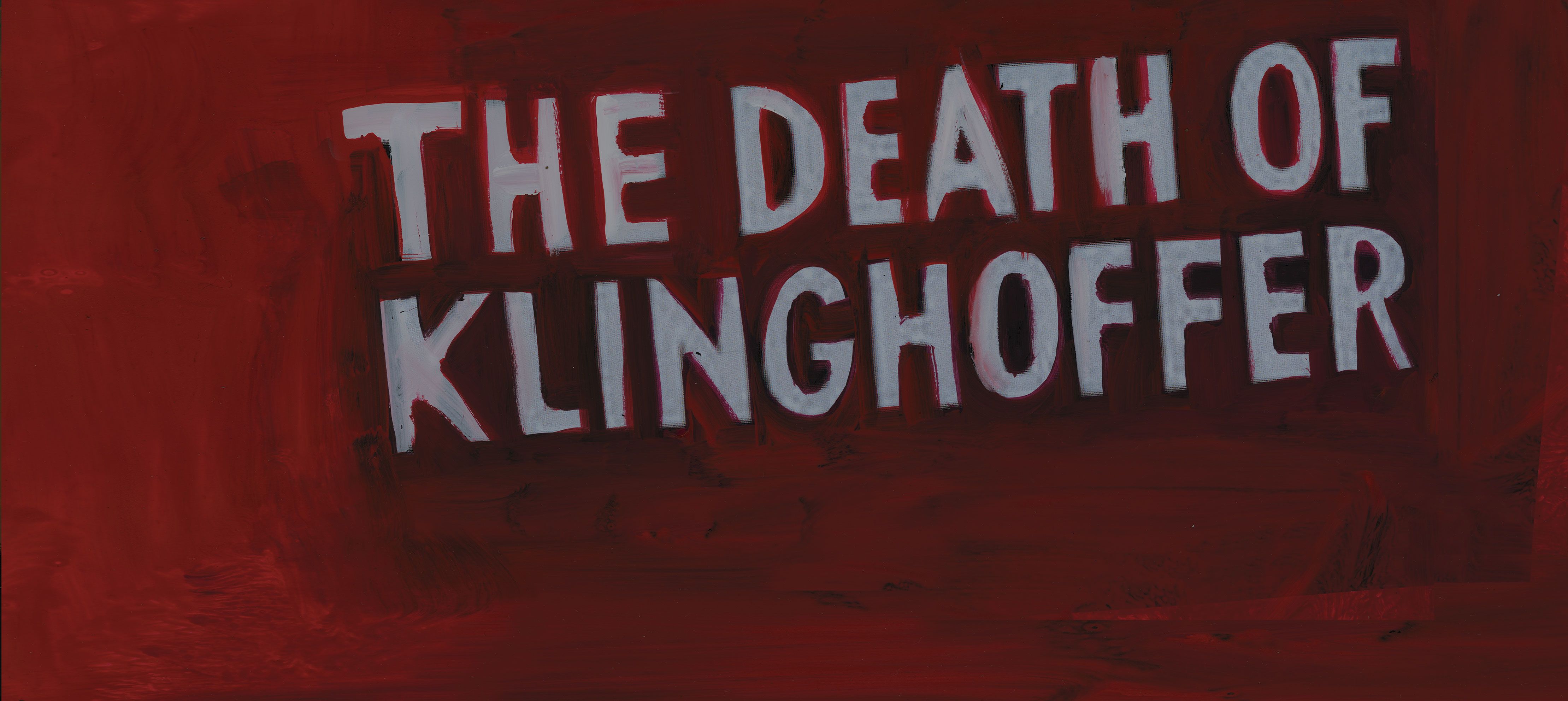
On Sunday, April 19 at 5:00 PM, in the Teatro’s Main Hall, the 88th edition of the Maggio Musicale Fiorentino Festival opens. On stage is The Death of Klinghoffer, the opera by John Adams inspired by one of the most significant historical and international events of recent decades, namely the hijacking of the cruise ship Achille Lauro, which took place in October 1985.
On the podium conducting the Orchestra and Chorus of the Maggio is Maestro Lawrence Renes. The direction and set design of the production - never before performed in Florence - are by Luca Guadagnino.
There are two additional performances scheduled: April 22 at 8:00 PM and April 26 at 3:30 PM.
Thanks are extended to Ferragamo for its support.
Special thanks for costume consultancy to Ursula Patzak, and for the artwork to Berlinde De Bruyckere.
Thanks to Professor James Williams for historical consultancy.
Poster © Gianluigi Toccafondo
Florence, April 13, 2026 – A contemporary opera never before performed in Florence, the Florentine debut of Luca Guadagnino and Lawrence Renes, and a contemporary story that, even more than forty years later, continues to leave a mark through the human, historical, and political implications it still evokes. The Death of Klinghoffer, a work of strong political and civic impact, is the production that raises the curtain on the 88th Festival of the Maggio Musicale Fiorentino, thus renewing its great tradition of presenting new or very rare contemporary works.
The opera, composed by John Adams, has never been staged before at the Teatro del Maggio, just as his compositions are entirely new to Florence. On the podium in the Main Hall, leading the Orchestra and Chorus of the Maggio, is Maestro Lawrence Renes, a true specialist, performer, and profound connoisseur of Adams’s works. Direction and set design are by Luca Guadagnino, one of the most acclaimed film directors worldwide, who for the first time directs a production at the Teatro del Maggio. The Chorus Master is Lorenzo Fratini, choreography is by Ella Rothschild. Costumes are by Marta Solari, lighting by Peter van Praet, and Mark Grey is the sound designer.
There are three performances scheduled in the Main Hall: April 19 at 5:00 PM, April 22 at 8:00 PM, and April 26 at 3:30 PM.
The opening performance on April 19 will be broadcast live on Rai Radio 3 and later the same day on Rai 5 at 6:00 PM.
“I am particularly pleased to inaugurate the Festival of the Maggio with The Death of Klinghoffer by John Adams, in a new production entrusted to the direction of Luca Guadagnino and the conducting of Lawrence Renes,” says Carlo Fuortes, Superintendent of the Maggio. “It is an extraordinarily rich, complex, and profound work, with a libretto by Alice Goodman, which I consider among the most intense, harsh, and poetic texts of the postwar period. It is a writing dense with references, with citations to the sacred, which over time has not always been received and interpreted in its full nature as a work of art, nor evaluated in its entirety.
An opera house must not limit itself to entertaining, but also has the task of engaging with the great issues of our time, always through an artistic language. When, two years ago, Guadagnino and I began to imagine this project, the relevance that now surrounds this work could not have been foreseen. And yet its staging avoids any form of speculation or direct reference to the present. Precisely for this reason, the choice to open the Festival with this title fully embodies our idea of opera: a theatre capable of speaking to today, to the issues that concern all of us, without turning into a treatise on geopolitics, but elevating the discourse through the power of artistic language.
In this sense, Adams’s work stands out for its extraordinary balance, giving voice to all parties involved - Jews, Palestinians, and all the protagonists of the story - with truly rare restraint and depth. We are not faced with a chronicle, but with a transfiguration that approaches the solemnity of an oratorio. Goodman herself emphasized this nature, a vision shared by Guadagnino and Renes, which I would compare, in breadth and scope, to a true ‘Passion’ in the Bach tradition.
The Death of Klinghoffer, in my view, is a work that stimulates thought and invites reflection without imposing answers. It leaves questions open, as great works of art do. This is the space that theatre must be able to offer today, and I hope that audiences will embrace it in its extraordinary depth.”
“Taking on The Death of Klinghoffer means confronting one of the most complex and profound scores of our time” - echoing the words of the Superintendent, conductor Lawrence Renes continues: “The music of John Adams, a composer I admire and whom I can call a friend, possesses extraordinary beauty, but it also demands an enormous effort from everyone involved: orchestra, chorus, singers, and conductor. In some ways, it is a musical Everest, a challenge that tests every level of performance. I have not had the opportunity to conduct it before - this is a debut for me - and for that reason I am particularly pleased to be involved in this Florentine production, also because I have the chance to work with Luca Guadagnino, whose love for Adams’s music I know well and which he has always carried into his cinema. In this opera, word and music are inseparably linked. Every rhythmic choice, every melodic inflection arises directly from Alice Goodman’s text: there are no traditional forms such as aria or recitative, but a continuous flow in which the music shapes itself around the language, the rhythm, and the meaning of the words. It is a style of writing that demands absolute precision, yet at the same time achieves moments of intense emotion and even transcendence. From a sonic perspective as well, Klinghoffer is a deeply contemporary work: the use of electronics, synthesizers, and amplification is not intended to increase volume, but to engage with our modern way of listening, creating an immersive and direct experience. But beyond the technical aspects, what truly makes this opera essential is its human dimension. Klinghoffer invites us to enter the complexity of the characters’ lives and experiences, without simplifications, without immediate judgments. It asks us to listen, to understand, to embrace different perspectives, even when they are difficult or uncomfortable. It is a work that speaks to our present with surprising force and, for this very reason, requires from the listener a deep openness, free of prejudice.”
Director Luca Guadagnino comments: “I wanted to bring The Death of Klinghoffer to the stage because it is an opera I have known and loved for a long time, but which one rarely has the opportunity to see performed. For this reason, I am grateful to Carlo Fuortes for accepting my proposal, which brings me here to the Maggio for the first time, with Lawrence Renes on the podium - a conductor I had the opportunity to appreciate years ago in London, again in an Adams opera, Doctor Atomic. Klinghoffer is an opera that I consider, together with Nixon in China, one of the great masterpieces of our time: a work born from a radical artistic collaboration between John Adams, Peter Sellars, and Alice Goodman, and one that possesses a power capable of penetrating deeply into the spectator, getting under their skin. The so-called scandal that has accompanied Klinghoffer is not, in my view, political in nature, but human. This opera confronts us with the complexity of the human soul and asks us to engage with it without retreating into simplistic interpretations. There is no black and white, no clear-cut categories of good and evil: to think in those terms is to betray the very nature of the work. The heart of the piece lies in its ability to demand from us a profound act of empathy. All the characters—and we with them—are called to enter into the experience of the other, even when distant, even when difficult to accept. It is not about justifying, but about understanding: recognizing that humanity is made up of relationships, tensions, and shared fragilities. In this sense, Klinghoffer is a deeply psychological theatre, almost a collective confession. My work has been to try to restore its truth, freeing it from the ideological encrustations that have conditioned its reception over time, and bringing it back to its purest dimension: that of an inquiry into human interiority. John Adams’s music is intimately connected to this vision, and in this regard I wish to emphasize the perfect harmony with Lawrence Renes: it is music that does not simply accompany the stage, but is the living flesh of the narrative, deeply connected to both the story and History. At certain moments it reaches an almost transcendent dimension, exactly as Renes says, as if it were an oratorio - and on this I agree with Fuortes - giving form to the inner life of the characters, even in its most contradictory aspects. In my directorial approach, I have sought to respect the specificity of the operatic language, without superimposing cinematic logic onto it. Musical theatre requires an autonomous creative process, and it is precisely in this dialogue that I found the opportunity to question myself and seek new forms of expression. I believe that today, more than ever, this work has something urgent to say: it invites us to suspend judgment and to exercise a deeper, more complex, more human gaze upon the world and upon the Other.”
An important aspect of the Festival’s opening production is the choreography conceived by Ella Rothschild, who emphasized its importance in further highlighting the music and its narrative role within the performance: “In the opera, what moves me is already present in John Adams’s extraordinary music and in Alice Goodman’s powerful libretto. The choreography belongs to this richness and allows it to unfold further. For me, it creates a way of lingering a little longer on what the opera already contains: compassion, sadness, loss, justice, violence - all these currents that run so powerfully through the work. It can open up the space slightly, slow down time for a moment, and allow these emotions to pass through the body, as well as the voice and the word. This changes the texture of the experience: the music is heard differently, the text arrives differently, and the inner life of the opera emerges in another light. I believe that the dance has created a kind of damnation in which nothing is overly explained, and yet something becomes profoundly clear.”
As its very title suggests, the opera turns its narrative gaze to one of the most significant international historical events of recent decades: the hijacking of the Achille Lauro, the Italian cruise ship seized in the early afternoon of October 7, 1985, by a commando of four terrorists from the Palestine Liberation Front, a dissident faction of the better-known PLO, the Palestine Liberation Organization. During the tense and frantic hours that followed the hijacking—which, as is well known, led to the murder of Leon Klinghoffer, an American citizen of Jewish faith, wheelchair-bound, who was on the cruise to celebrate his wedding anniversary-international relations went through extremely delicate moments. This culminated in a complex diplomatic situation between Italy and the United States, reaching its peak in the so-called “Sigonella Crisis.”
The Death of Klinghoffer is structured in a prologue and two acts and is based on a libretto—here a work of poetic art—written by the poet Alice Goodman. It was first performed in Brussels at the Théâtre de la Monnaie in 1991. In Italy, it was staged for the first and only time in 2002 in Ferrara and Modena.
The cast includes Daniel Okulitch as The Captain; Laurent Naouri as Leon Klinghoffer; Susan Bullock as his wife, Marilyn Klinghoffer; Marina Comparato in the roles of both the Swiss Grandmother and the Austrian Woman; and Joshua Bloom as Rambo, the leader of the terrorists. The company is completed by Andreas Mattersberger as the First Officer; Roy Cornelius Smith as Molqi; Levent Bakirci as Mamoud; Janetka Hoșco as the British dancing girl; and Marvic Monreal as Yazmir.