June 5, 2024, 8 pm: Gamo ensemble concert dedicated to Luigi Nono
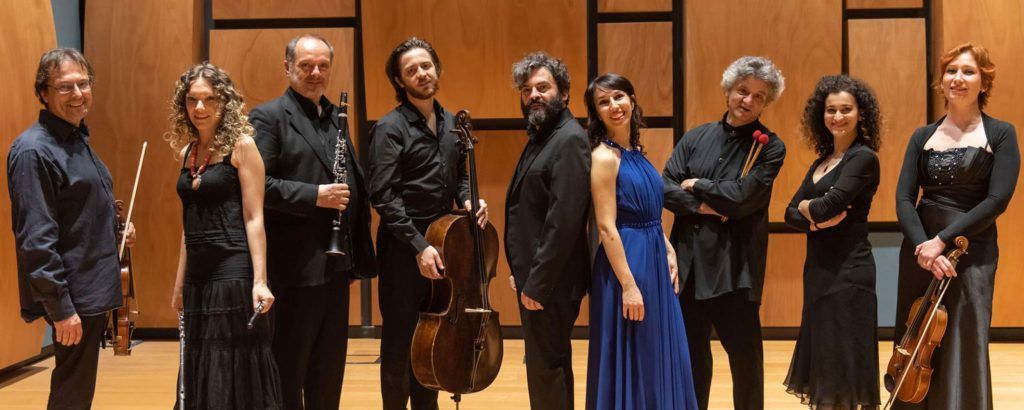
Wednesday 5 June 2024 at 8 pm the GAMO Ensemble in concert in the Sala Regia of the Teatro del Maggio.
Music by Luigi Nono is on the program.
Conductor Francesco Gesualdi.
On the occasion of the 100th anniversary of the birth of Luigi Nono
Single seat €10
Florence, June 3rd 2024 – As part of the 86th Maggio Festival, the GAMO Ensemble returns, five years after their last performance in the theatre. The concert performed in the Sala regia del Maggio - open to the public for the first time - on 5 June at 8pm, offers a program entirely dedicated to the music of Luigi Nono, one of the most talented Italian composers of the second half of the twentieth century, on the centenary of his birth : opening the evening Homage to György Kurtág, a 1983 song composed to lyrics by György Kurtág; follows Das atmende Klarsein, fragmente for bass flute, magnetic tape and live electronics, composed in 1981;...Suffered serene waves... for piano and magnetic tape from 1976 and, in closing, Polifonica-Monodia-Ritmica, among the first compositions of Luigi Nono's career, from 1951.
The GAMO Ensemble (Gruppo Aperto Musica Oggi) – one of the most illustrious Italian institutions dedicated to contemporary music – has already been a guest several times over the course of the Maggio seasons and is led by Francesco Gesualdi. Sound direction is handled by Alvise Vidolin. The Ensemble is made up of Roberto Fabbriciani on the flute and Ilaria Baldaccini on the piano. Together with them Patrizia Scivoletto, contralto; Giovanni Ricucci, clarinet; Stefano Franceschini, bass clarinet; Mario Barsotti, bass tuba; Michele Bianchini, alto saxophone; Paolo Faggi, horn and Omar Cecchi, Nazareno Caputo, Mattia Ferrante and Dimitri Paci on percussion.
The concert:
The Venetian composer Luigi Nono, whose hundredth anniversary of his birth is celebrated this year, was undoubtedly among the greatest artists of the second half of the twentieth century. A pupil of Malipiero, Maderna and Scherchen, frequenter of the Ferienkurse für neue Musik in Darmstadt, at the beginning of his career Luigi Nono embraced the technique of serialism without however considering it an absolute dogma of making music. An attentive and fine listener of the sounds that surround him, Nono explores every nuance, down to the most subtle, creating compositions, also with the aid of electronic music, where the music seems to emerge from nothing and dialogue with silence.
The concert proposed by GAMO traces the evolution of the composer's style backwards: from post-avant-garde deconstructivism to the first works born in the wake of the post-Webernian experiences of the 1950s.
Presented in Darmstadt in 1951, Polifonica-Monodia-Ritmica was hailed as the most interesting post-World War II composition. In it Nono adopts an unorthodox serialism in which the series, for example, is not represented by the totality of the twelve notes but is configured through the repetition of a simple rhythmic-melodic cell. The juvenile page is divided into three pieces connected to the different aspects alluded to by the title: the polyphonic fabric that is gradually built starting from a simple codicil cell; the cantability "listening to the silences, the songs and the echoes", as the author wrote, and the dense rhythmic interweaving entrusted only to percussion.
….. Suffered serene waves … for piano and magnetic tape was premiered on 17 April 1977 in the hall of the Milan Conservatory by Maurizio Pollini, to whom the piece is dedicated. A meditative page, it stands out for the prominence assumed by the sound and for the formal conception in fragments. Nono concentrated on the sound of the piano in its nature as a percussion instrument, putting it in dialogue with its double - the piano recorded on magnetic tape - in a game of sound references and refractions. Das atmende Klarsein, fragmente for bass flute, magnetic tape and live electronics (1981) and Omaggio a György Kurtág (1983) for contralto, flute, clarinet, bass tuba and live electronics are instead works born after a long period of research and experimentation conducted by Luigi Nono, some musicians and sound engineers in the Experimental Studio of the Heinrich Strobel Foundation in Freiburg. On both pages Nono focuses on how instrumental and vocal sound is produced combined with live or pre-recorded electronics. A research that pushes itself to the limit of the audible, often involving the usual ones in passages halfway between breath and sound within the dynamics of pianissimo.
GAMO Ensemble:
The GAMO is one of the oldest and most illustrious Italian institutions dedicated to contemporary music. Founded in 1980 by Giancarlo Cardini, Liliana Poli, Vincenzo Saldarelli, Albert Mayr and Massimo De Bernart, it has been operating in Florence for over forty years organizing concert seasons, master classes, seminars and conferences. Among the most well-known contemporary composers who have participated, or even just attended, in the Gamo concerts dedicated to them, which often have seen and still see world premiere performances in the program, including Goffredo Petrassi, John Cage, Giancarlo Pennisi, Brian Ferneyhough, Sylvano Bussotti , Paolo Renosto, Salvatore Sciarrino and Alessandro Solbiati. The artistic direction, which has been under Giancarlo Cardini for more than thirty years, is now under Francesco Gesualdi, who has given a new face to GAMO, founding an Ensemble in residence. The GAMO Ensemble, directed by Gesualdi himself, has a large repertoire of music from the historical contemporary panorama and many new compositions by composers of the current music scene, which in many cases were written specifically for the Group and usually included in unpublished projects and productions.